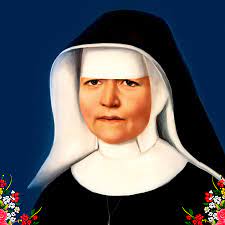
Francisca Nisch was born on September 18, 1882 in Oberdorf-Mittelbiberach, Diocese of Rottenburg-Stuttgart in southwest Germany. Though conceived outside of wedlock, she was nevertheless welcomed, and was baptized the day after she was born. Her mother had met a groom (stablekeeper) she fell in love with at the village inn where she worked. Their parents refused to give their consent to the marriage they both wanted, so they thought having a child would get them the permission they hoped for. It was another year after Francisca’s birth before Ulrich and Clotilda Nisch could marry. They moved to Unterstadion, a little village near the Danube. They would have fourteen children, of whom only five would reach adulthood—Francisca was the eldest. Shortly after her birth, she was placed in the care of her grandmother and her aunt Gertrude, her godmother, who lavished affection upon her and gave her a Christian upbringing. Aged six, Francisca returned to her parents’ home. Mr. Nisch was very strict and sometimes acted harshly toward his eldest child. Nevertheless, Francisca grew up as an exemplary girl, fulfilled her duties conscientiously and showed the greatest respect towards her parents, drawing her strength from prayer from this time on.
Francisca earned average grades at the school in Unterstadion, but she was a very assiduous catechism student. After school, she would return home to do whatever she could to help the family. “Francisca was truly good,” one of her friends would later say. “ She was calm and a little awkward, She didn’t think of herself, and did not draw attention to herself in anything.” After five years of school, the girl returned to the home of her aunt Gertrude to help her in the kitchen of the inn she ran with her husband, and to look after her three boys.
On April 21, 1895, she made her first Holy Communion and, the same year, received Confirmation. In 1898, Francisca moved into the home of an uncle who owned a grocery in Sauggart where she worked and thus helped her parents financially. However, the work exceeded her strength, she had to look after the business and the housework, and care for very young children, alongside her mentally ill aunt. Day after day, unreasonable criticism and complaints rained down on her. At the end of a year, she left Sauggart and went to Biberach to work in a bakery. Here she learned that German servants were better paid in Switzerland than in their own country, so in October 1901, she entered into the service of the Morger family in Rorschach, Switzerland, where she took care of four children.
In 1904, Francisca suffered a bout of facial erysipelas (an acute skin infection) so serious that her life was feared for. At the hospital, she made the acquaintance of the Sisters of the Holy Cross of Ingenbohl. The sisters not only nursed her back to health but their spirit of sacrifice, prayer, and abandonment to God made such an impression on Francisca that she decided to become a nun. On October 17, 1904, she entered the Institute of the Sisters of the Holy Cross, in their convent in Hegne, a small German village on the shore of Lake Constance. She was assigned to help in the kitchen. The work was exhausting and required sacrifices, such as often having to go without Mass and Communion during the week, and missing common prayer and recreation. During the second part of her postulancy, she was sent to another house, in Zell-Weierbach. At this house, there were only three nuns and the Superior, who was elderly and suffering, and in need of an assistant. Francisca replaced her in the kitchen, worked on the upkeep of the house, which soon gleamed with cleanliness, and cared for the sick. Rather than her piety suffering from this, it became even more intense.
Francisca was sustained by the gift of piety. Awareness of being a child of the Father removed Francisca from all anxiety and lack of trust in God and His Providence. She learnt to make her work a prayer and she also realized that Christ was her Spouse, and that she was very closely united to the Holy Spirit. She also had a great devotion to the Blessed Virgin, Saint Joseph, Saint Francis of Assisi, as well as her guardian angel. From childhood she had been blessed with the special privilege of being able to see her guardian angel. In her innocence, she thought that everyone was able to do so. When she realized her error, she was upset for days, fearing that this grace was only an illusion.
On April 24, 1905, Francisca began her novitiate and took up the name Sr. Ulrika (after her father’s first name, Ulrich and Saint Ulrich who was the bishop of Augsburg). The next day, she returned to her work in the kitchen. This was not what she had longed for. The work was hard, but she was able to adapt to this situation. When asked, “How do you manage to bear the heat of the stove, endure the humiliations, and get so much work done?” she invariably replied, “Out of love for the Saviour. For the Saviour, one can do everything.”
Sr. Ulrika was sometimes absent-minded and, now and again, a mishap occurred. One evening as she was preparing a refreshment for the sisters who would be toiling over the laundry until late into the night, she forgot to take it to them. Another time, having promised a novice to load the stove for her, she put the coal not on the fire but in the ash-pan. This earned her severe rebuke, but she maintained her calm. “One can at least make her some remarks,” noted Sister Adama, the cook in charge; “she does not take offense at it in the least.”
Sr. Ulrika made her religious profession on April 24, 1907. She continued to live community life simply and humbly. She was always present at community prayer, meals, and recreation when her obligations did not keep her in the kitchen. She was able to laugh heartily with the others. However, she continued to be drawn to contemplation. “Yes,” she wrote in her diary, “I even have trouble saying the Breviary. I always feel driven to repose in love.” She allowed herself to be guided by the gift of wisdom that enlightened her soul and that led her to savor the things of God.
The day after her profession, Sr. Ulrika was sent to Bühl, Germany, where she oversaw the hospital kitchen. Here, contrary to all expectations, Sr. Ulrika who knew when to give in or wisely prevent problems managed to live in peace with a stubborn and inflexible maidservant who also worked in the kitchen who had caused the nuns continual problems. It was truly a relief for the Superior. Sr. Ulrika knew, with an amazing certainty, how to seize the opportune moment, find the right word, do what had to be done, thanks to the gift of counsel.
One day when she was asked what she meditated on, Sr. Ulrika replied, “On God’s attributes. What I love most is to contemplate the divine simplicity.” She perceived the profound meaning of the Holy Sacrifice of the Mass, which for her was “the greatest thanksgiving, the most elevated and most powerful sacrifice of supplication, the greatest joy and the greatest happiness.” She “spoke of the divine attributes so sublimely,” one of her sisters recounted, “that, with my weak human understanding, I didn’t comprehend it, and I was astonished—where did this simple sister get such knowledge?”
In October 1908, Sr. Ulrika was transferred to the Saint Vincent house in Baden-Baden, of which Sr. Bonaventura would soon become Superior. Capable, energetic, meticulously exacting, this Superior gladly made her superiority known to others. As she came to know the young sister working in the kitchen, Sr. Bonaventura became convinced of her rare virtue. Sr. Ulrika worked under the direction of a sister who lacked self-control and acted rudely toward others. Sr. Ulrika’s simplicity aggravated her, and she became jealous of the veneration the other kitchen workers had for her. One day, her irritation peaked, and led her to harshly humiliate her assistant. The young sister remained silent, but could not hold back her tears. Discreetly slipping away to take refuge in the chapel, she returned shortly thereafter, her cheeks still wet, but her face calm and smiling. One sister who witnessed the incident reported, “I would have really scolded Sr. Ulrika for allowing herself to be treated like that without reacting. If it were me at that moment, I would have been capable of knocking that sister senseless.” The Superior would later say, “If Sr. Ulrika had not received remarkable graces, she would not have been capable of enduring her great trials with such serenity.” For her the kitchen was simply a subsidiary chapel, for in it she lived in a state of constant union with God, noted for her humble joy and her patience with all. A heroine among the pots and pans!
Sr. Ulrika suffered from severe headaches and a catarrh. She courageously endured the surgery that became necessary, then calmly took up her work again. She was convinced that if one trusted in God and in His help, one would not be abandoned. “No confidence in myself, but full confidence in God, that’s the best,” she said.
Peaceful and joyful, Sr. Ulrika kept up everyone’s spirits with amusing retorts. She taught beautiful hymns to the young women she supervised in the kitchen, and sometimes even danced with them. Her love for her neighbor was revealed in particular toward an unfortunate employee, Gusti. When she was quite young, she had been working in an inn where she met a seducer. Pregnant and abandoned, tortured by anguish and despair, she gave birth to a child that she threw in a ditch. Sentenced to three years in prison, she was soon paroled for good behavior. The Sisters of the Holy Cross had taken her in, but those around her kept an eye on her and distanced themselves from her. Informed of what had happened to this young woman, Sr. Ulrika began to give her special attention. It was difficult, because the young woman had an implacable hatred for everyone. Sr. Ulrika prayed and offered God her daily humiliations and sufferings for her protégée’s conversion. Little by little, thanks to Sr. Ulrika’s little kind gestures, smiles, and words of comfort, Gusti’s mood changed and she became sociable. “Sr. Ulrika gave me a new soul,” she would later affirm. Gusti eventually became happily married.
Sr. Ulrika expressed one of her greatest sufferings in these words: “In spite of the numerous graces, still many flaws!” She was referring to lapses that escaped others’ notice, errors of weakness, omission, and haste due to human weakness. She confessed to a priest: “Relations with my fellow sisters are becoming more difficult by the day. I can’t put up with much of anything, especially in the morning. If only nobody would say anything“ because often I am so mad!” She commented again: “I am not happy with myself at all “how weak I am on this point (love of food)!” Nevertheless, she wrote to a Sister: “We can and we must weep for our sins, but we must not lose courage and become fearful. Every mistake must strengthen you in humility and be useful to you in making you realize your nothingness more and more.”
Sr. Ulrika was imbued with the gift of fear of the Lord. She begged for mercy for all sinners: “O gentle Heart of Jesus, save them! Cure Your people! If I could make them all know Love, and make them feel Jesus’ blazing thirst!”
In 1912, Sr. Ulrika became very weak and mustered all her strength to continue her work. A medical examination revealed that she had an advanced case of tuberculosis. The patient did not seem surprised. To her Superior, who reproached her for having kept quiet about her illness, she replied, “We’re going home. Our homeland is in heaven and not here on earth. I am glad to be dying.” This aspiring for the celestial homeland made her say: “We must have more concern for the future life that lasts forever, than for the earthly life that passes.” Enlightened by the gift of knowledge, Sr. Ulrika was aware of the brevity and insignificance of earthly things, of their inability to satisfy our hearts that are eager for true happiness.
Hospitalized, Sr. Ulrika received very attentive care. To those who expressed their sympathy to her, she replied, smiling: “When I am in heaven, I will pray for you.” She even found a way to joke about her new condition: “Now I’m leading the good life, like the patients who take the cure here—eating well, going for walks, sleeping!”
In September 1912, the doctors requested she be transferred to Hegne. There she did not receive spiritual direction, which was very painful for her. “I have no one with whom to speak about my interior life,” she wrote to Sr. Bonaventura. “Now I no longer have any consolations, neither divine or human, and sometimes it’s very hard.” Another suffering for her was the temptation to believe that everything she had experienced with the Lord was nothing but an illusion that had come from the enemy.
She spent her last days in uninterrupted prayer. Her rosary did not leave her hands. When her coughs shook her, she repeated, “Everything for my beloved Lord!” On the evening of May 8, 1913, a nurse came to her bed to see if she needed anything when, in the next room, another sick sister began a violent coughing fit. “Go first to that sister,” murmured Sr. Ulrika. When the nurse returned, Sr. Ulrika had died.
Sr. Ulrika Nisch was beatified by Pope John Paul II on November 1, 1987, which was the Feast of All Saints, at the Vatican. Her beatification marked her as "Blessed" within the Catholic Church, recognizing her holy life and service. Her feast day is 8th May.
Blessed Ulrika Nisch, obtain for us a great docility toward the action of the Holy Spirit in our lives.