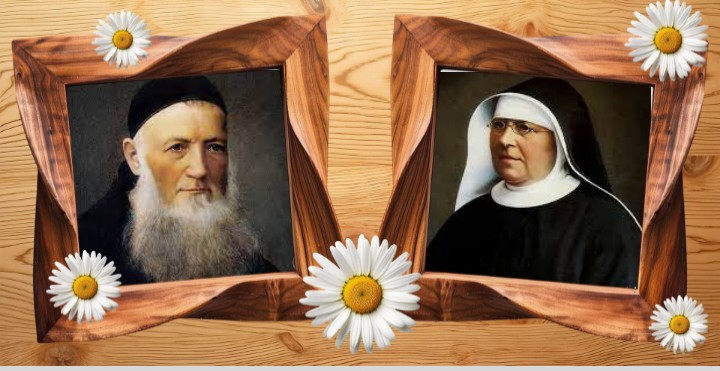
FR. THEODOSIUS FLORENTINI OFM Cap, FOUNDER SISTERS OF MERCY OF THE HOLY CROSS (1808 - 1865)
Fr. Theodosius Florentini(Anton Crispin) was born on 23rd May 1808, in the Munster Valley of Canton Graubunden in Switzerland. His father was Paul Florentini and mother was Anna Fallet. As he lost his father at the age of eight, his education was taken care by one of his elder brother who had joined the Capuchins and was teaching at Stans. His uncle was a Franciscan and taught in Meran. Both of them were concerned about the education of the fatherless boy.
Fr. Theodosius Florentini(Anton Crispin) was born on 23rd May 1808, in the Munster Valley of Canton Graubunden in Switzerland. His father was Paul Florentini and mother was Anna Fallet. As he lost his father at the age of eight, his education was taken care by one of his elder brother who had joined the Capuchins and was teaching at Stans. His uncle was a Franciscan and taught in Meran. Both of them were concerned about the education of the fatherless boy.
Unfortunately, the young priest died of typhus at the age of 27 and it was while praying at the grave of his brother that Anton Crispin felt his call and joined in the same order. At the age of eighteen, he made his vows as a Capuchin at Sitten and four years later he was ordained as priest in 1830. he was appointed novice master, and lecturer of philosophy and theology. In 1838 he became guardian at Baden of the Capuchin Monastery for eight years; in 1845 superior and parish priest at Chur and in 1857 definitor. In all these positions, he took an active part in cultural and political disputes and thus became the leading spirit among the Catholics of the Canton Aargau. He saw with all clarity the need to struggle for a new society.
In 1844, Fr. Theodosius founded the Institute of the Teaching Sisters of the Holy Cross whose Mother house is at Menzingen. Their constitutions enjoined upon them to make themselves all to all in order to win souls to Christ and to do nothing which might repel any from their mode of life. Later on in 1856, Father Theodosius founded the congregation of Sisters of Mercy of the Holy Cross at Ingenbohl. These congregations have been approved by the Holy See. Both are actively engaged in educational works; they have foundling asylums, orphanages, kindergartens, poor schools, boarding-schools for girls, and institutions for teachers. Both have in their homes for girls a patronage, as the French call it, for servant girls, factory workers, shop assistants, and others. The Sisters of Mercy have, besides, homes for the poor and sick, and undertake private nursing.
In 1860, he was nominated Vicar General of the diocese of Chur. Father Theodosius had a clear vision and saw and understood ten things where others hardly saw one. During his speeches and lectures he kept audiences spell bound. Fired by his enthusiasm they listened to him for hours. He was a man of quick decision and if he once conceived an idea, he would carry it out despite difficulties and opposition. With regard to the labour question Father Theodosius expressed himself very fully in his speech at Frankfort in 1863. In demanding the Christianizing of industry, trade unions, and workmen's credit banks, he said: "Formerly monasteries were turned into factories, now factories must become monasteries, and the profits must be shared with the workers". Factories were established to carry out this idea, but they failed, owing to a lack of business capacity in the founders.
Fr. Theodosius had a kind heart. He wished to help everyone. He would part with his last coin to enable a needy farmer to get wood to the train, whether a request was genuine or not, did not worry him much. He completely spent himself in education, care of the sick, the poor and the worker.
His ideas were simple, effective and concentrated on the solution of practical problems.
Fr. Theodosius was a man of practical energy. It was evident in small things. He understood every kind of handicraft and knew how to handle different types of machines. He knew how to work a typesetting machine and a hand printing press. He considered it important to have schools provided with necessary scientific apparatus. It was said of him that he could do anything and everything. The innate interest in tools and technical things probably led to his interest in factories and industries and taught him how to serve machines. Hence his idea to include various practical techniques in the educational and social programme.
Fr. Theodosius was like a physician who felt impelled to bring healing to his time. He wished to help all in their corporal and spiritual needs. He was convinced that such help could come only through the Church, by manifesting God’s love and on his part he looked upon his work as done in the service of the Church.
His ideas took practical shape: under his direction religious worked for the relief of the moral, intellectual and material needs of time. The two congregations founded by him at Menzingen and Ingenbohl helped him in realization of his plans.
Fr. Theodosius did all this through his boundless confidence in God. God was his partner in all his financial calculation. “Where would I be with your weak confidence in God,” he used to say to those of little faith.
He was very keen upon the care and inspection of the helpless and dependent, such as boarded-out children, apprentices, neglected children, and discharged prisoners.At Ingenbohl Father Theodosius founded a printing and book-binding establishment and a society for the distribution of good books. Among his own writings are the "Legends of the Saints" in four volumes. His spirit was well expressed in the saying of St. Augustine which on the eve of his death he wrote in the notebook of a teacher: "In necessariis unitas, in dubiis libertas, in omnibus charitas". A favourite maxim of his was: "Whatever is the need of the time, is God's Will".
Fr. Theodosius lived a life of great simplicity. He was a popular preacher and good confessor. It is said that at night he would keep his vigil of prayer in the crypt of the cathedral. The untiring worker, entangled in business, plans and cares said of him, “I do not think that there is an hour in my priestly life, when God was not consciously present to me. Death may strike me where it will never find me unprepared.” Before his death he had written these last lines:
In essential matters unity, In doubtful ones freedom, In everything love.
His people gave him a tomb stone that reads -
To a noble priest, The teacher of youth, The nurse of the sick, The father of the poor.
He died on 15th February 1865 at Heiden, in Appenzell. He died but his spirit will remain forever through Holy Cross Sisters all over the world.
THE LIFE OF BL. MARIA THERESA SCHERER, CO-FOUNDRESS OF THE SISTERS OF MERCY OF THE HOLY CROSS (1825–1888)
Blessed Maria Theresia Scherer was born on October 31, 1825, in Meggen, Luzern, Switzerland. She was the fourth of seven children of Charles Scherer and his wife Anna Maria Sigrist. At the age of seven when her father passed away, she moved into the house of her uncles the Sigrist family. The religious atmosphere at home, years of schooling, and the regularity of life on farm helped to mould Catherine’s character.
When she was 16, she went to work in the town hospital run by the Sisters of Mercy of Besancon.
Following a pilgrimage to Einsiedeln, she recognized her vocation and joined the Teaching Sisters of the Holy Cross, or Menzingen Sisters, an order founded in 1844 by Theodosius Florentini (1808–65). She was one of the first five members;on 27th October 1845 took her first vow as Sr. Maria Theresa. She began her mission as a teacher, serving in various Swiss cities such as Galgenen, Baar, and Oberageri, living a life dedicated to serving God and others. She loved teaching but God had His own plan for her.
In 1850, Sr. Maria Theresa's compassion for the poor and orphans led her to take charge of a home for them in Nafels, Switzerland. The local community quickly recognized her selfless dedication and affectionately called her the "mother of the poor." In 1852 Fr. Theodosius called her to Chur, where she was entrusted with a responsibility of an administration of the hospital. This marked the beginning of splitting the Sisters into groups devoted to teaching and other works of mercy.
The teaching Sisters eventually left in 1856, and Sr. Maria Theresa became the co-founder and first superior (1857–88) of a new congregation called the Sisters for Schools and Care of the Poor. This congregation later became known as the Sisters of Mercy of the Holy Cross of Ingenbohl. Mother Maria Theresa, as she was now known was noted for her energy, sacrifice of self, and ability as organizer and administrator.
After the sudden death of the founder, the co –foundress Mother Maria Theresa, gave life and growth to an endangered Institute by her dynamic personality. She worked tirelessly for the expansion of the Sisters' service that by the time of her death, there were over 400 convents with more than 1500 sisters, and Mother Maria Theresa was considered a living embodiment of their holy rule.
Throughout her life, Mother Maria Theresa dedicated herself to serving those in need. The Sisters of Mercy under her guidance cared for the poor, orphans, patients in military hospitals, and ministered to prisoners. Her selflessness and devotion to God were evident in every aspect of her work.
She walked the way of the cross with fortitude and trust in God. To her sisters she was a mother and guide, to the poor and afflicted a compassionate healer.
On June 16, 1888, Mother MariaTheresa Scherer passed away in Ingenbohl, Schwyz, Switzerland, due to natural causes. Her remarkable life of virtue and holiness did not go unnoticed. In recognition of her heroic virtues, she was venerated on April 2, 1993, by Pope John Paul II. Later, on October 29, 1995, Pope John Paul II beatified her, acknowledging her as Blessed Maria Theresa Scherer, a model of faith and service to the Church.
Today, the Sisters of Mercy of the Holy Cross of Ingenbohl continue to carry on the good work begun by Blessed Maria Theresa Scherer. They serve the poor, care for orphans, educate children, tend to patients, and offer spiritual guidance and support to people. Blessed Maria Theresa Scherer's legacy lives on as an inspiration to all who strive to imitate her selfless love and devotion to God.