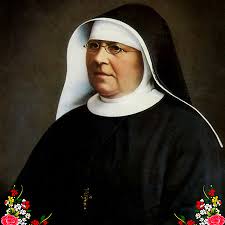
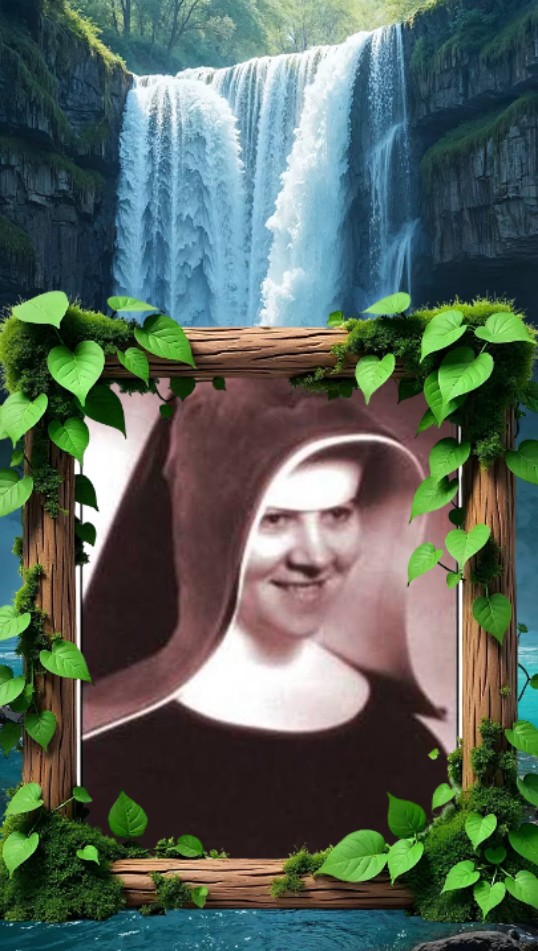
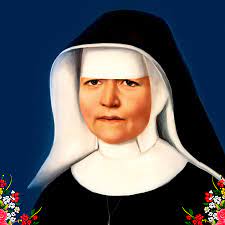
Cecilia Schelingová was born on Christmas Day 1916, the tenth child in a peasant family of Pavol Schelingová and Zuzana Pániková, in Krivá Orava, the mountainous region of northeastern Slovakia, at the time part of the Austro-Hungarian empire. From an early age the children acquired a sense of responsibility and of sacrifice from their parents and, above all, a deep and practical faith.
Cecilia attended the local elementary school from 1922 to 1930. In 1929, the Congregation of the Sisters of Mercy of the Holy Cross arrived at Cecilia's parish, to teach children. Their level of instruction was remarkable. They also provided generous care to the sick and introduced new agricultural methods. The presence of their order helped her to see that God was calling her to religious life. She was particularly impressed by the Sisters' unconditional love and disciplined lifestyle.
Of a delicate and sensitive constitution, Cecilia nevertheless possessed a combative temperament. Lively and intelligent, she could lead her friends into mischief. Once she got an idea, she didn’t think about the consequences… One day, at her instigation, the students in her class raised the chair of a short schoolteacher so high that when he sat down in it, it toppled over and he fell off, to the great delight of the children. Cecilia learned easily. During tests she would secretly help those nearby.
Nevertheless, fascinated by the ordered life of the nuns who taught her, she asked, at the age of fifteen, to enter the Congregation. In 1931, when Cecilia was 15 years old, she went to the Provincial House of the congregation in Podunajské Biskupice, accompanied by her mother, to ask permission to join the order. However, before her entry into the novitiate in 1936, she was sent to nursing school and then took a specialized course in radiology. After four years of studies, Cecilia obtained her nursing degree, and on January 30, 1937, she made her first vows. She was given the typically Slavic name Sr. Zdenka, which can be translated “Sidonia.”
Until 1942, Sr. Zdenka devoted herself to work in a hospital in the middle of eastern Slovakia. She was then called to the public hospital in Bratislava. Meticulous, endowed with an inborn sense of order and cleanliness, as well as a keen sensitivity that enabled her to understand the sick, she won the affection and appreciation of doctors and patients alike. Prayer was the soul of her life: “In my hospital service,” she said, “I go from the altar of God to the altar of my work… I’m not afraid of anything and I try to undertake everything with joy. I proclaim the Gospel more by example than by words, just like Christ, Who manifested Himself through the witness of His life.”
At the end of February 1948, the Soviets imposed Communism on Czechoslovakia. Industry and private property were nationalized. Agrarian reform dispossessed the Church. Most newspapers were shut down. In April 1949, a commission was created to systematically suppress the Catholic Church. In 1950, the monasteries and convents were closed on the false pretext that they were centers of revolt against the democracy of the people. Nuns working in hospitals could temporarily stay on, due to a shortage of qualified substitutes. Many priests, seminarians, and religious tried to flee to the West, but there was no legal way to leave. Any help given to someone trying to flee was considered treason, resulting in the severest punishment.
Fr. Sandtner, a priest who had unsuccessfully tried to escape, was taken, gravely ill, to the hospital in Bratislava. Sr. Zdenka took special care of him. In spite of the fact that it was absolutely prohibited, he celebrated Mass in her presence in a small room. When his condition improved, it was expected that he would return to prison, but the Sister managed to prolong his stay in the hospital. Sr. Zdenka’s attitude gave rise to a series of increasingly sharp confrontations with the regime in place. In 1951, a very active priest, Stefan Kostial, was imprisoned and tortured for having attempted to flee the country. Completely exhausted, he was taken to the hospital in Bratislava where Sr. Zdenka showed herself full of concern for him. Having regained some strength, he was to appear in court to be sentenced, on February 20, 1952. Sr. Zdenka then made contact with people who could help him escape. The night of the 19th, she prepared tea for the guard and put a sleeping pill in it. Stefan Kostial managed to escape. A few days later, another attempt to help some other priests escape failed.
On February 29, the police raided the hospital. A witness related, “The police searched the hospital. A nun was arrested before our eyes. Seeing this scene, Sr. Zdenka exclaimed, ‘Next time, it’s my turn!’ She called me over and begged me to take and hide some documents she had on her… As soon as I left the building, the police asked me where Sr. Zdenka was. She was hurriedly gathering some toiletries together before she was found… They finally found her and took her along with the other Sisters.” It was later learned that the truck driver who had taken part in the priests’ escape was a spy for the State, charged in particular with spying on, and informing against, the women.
Sr. Zdenka wrote, “Do not be afraid to suffer. God always gives the necessary strength and courage. I believe always in His grace. Nothing will shake me, not the storm nor the menacing clouds. If they come, it will be for a short time, and they will only reinforce my confidence and my certainty.” In beatifying her, Pope John Paul II said, in the same vein, “The Cross is planted in the earth and would seem to extend its roots in human malice, but it reaches up, pointing as it were to the heavens, pointing to the goodness of God. By means of the Cross of Christ, the Evil One has been defeated, death is overcome, life is given to us, hope is restored, light is imparted.” Sr. Zdenka faced this harsh experience.
The State police wanted to wring from her details about the escapes, above all the names of the accomplices, but she revealed nothing. She stated later, “They wanted to make me confess untrue and falsified facts.” Faced with her absolute refusal to lie, the guards submitted her several times to the torture of suffocation. “This torture would come to an end when, completely worn out, I was on the point of passing out,” she later said. “Then they would put a pair of dark glasses on me and drag me through the corridors of the prison, to a dark cell in solitary confinement… When I regained consciousness, I looked all around me for something to slide under my aching head. Since there was nothing, I took off my shoes and used them for a pillow. In any case, they were softer than the cement floor.”
In jail because of her charity toward priests, Sr. Zdenka probably could have avoided many sufferings by agreeing to tell some lies or inform on others, but she always refused. Faithful to the truth, Sr. Zdenka was subjected to more torture sessions, in which her entire body was beaten. Only the conviction that God was protecting her gave her the strength to endure these sufferings. During the entire pre-trial period, Sr. Zdenka was confined to a windowless cell, alone, sitting, shivering from the cold. “I no longer knew,” she said, “if it was day or night, and I had no idea how long this isolation would last. After what seemed like forever, I was suddenly transferred to another cell. There, they gave me something to eat and drink—in front of the judges, I had to look better!”
On June 17, 1952, she appeared before the court in Bratislava for collaborating in the attempted escape of six Roman Catholic priests. Seated on the defendant’s bench, Sr. Zdenka seemed to have aged several years. Suffering and fear were written on her face. The court sentenced her to twelve years in prison for high treason. She was also accused of being “Enemy Number One” of the peoples’ democracy. Under the eye of a member of the national security, she signed the following declaration: “I am aware of the accusations and the conclusion of the trial. I do not believe myself guilty. I acknowledge the acts that are attributed to me, but I deny the charge of high treason. The warden had spread the news that the priests would be deported to Siberia and put to death. I was deeply distressed and I wanted to save them. It was out of pure compassion that I made the decision to help them escape. I was too naïve in believing the warden’s words. But this does not make me an enemy of the peoples’ democracy.”
Sr. Zdenka was incarcerated in the prison in Rimavská Sobota. There, the prisoners were watched so that no friendship might form between them. The conditions there were deplorable—the walls gray and damp, the bars rusted and the corridors smelling of mildew. Sr. Zdenka compared the guards and the staff to robots. She felt truly alone, and all the more misunderstood because some of her fellow Sisters had interpreted her charitable acts toward the escapees as disobedience to the ecclesiastical superiors, who had given strict orders not to provoke the government, so as not to attract even more hatred and problems. When she learned of this criticism, Sr. Zdenka was deeply hurt.
A young woman, Apolónia Galis, who would become a nun of the Holy Cross and die at the age of 78 on June 21, 2003, visited her in prison and secretly brought her cakes to which she had added vitamins. She recounted, “Sr. Zdenka, pale and thin, was seated behind a large table. A guard was stationed behind her and closely watched our every move.” In a letter sent in secret, the Sister let out a veritable cry of despair; a call for help that her living conditions might be improved and she might be given medical care while she was in prison. Worried sick, Sr. Zdenka’s mother and younger brother decided to visit her. They were allowed to enter, but it was made clear to them that they could not show any feeling or emotion, or else the meeting would be cut short.
After a year and a half of imprisonment, Sr. Zdenka was transferred to the prison ward of the Prague hospital, where she was operated on for a cancerous tumor in her breast. After the surgery, Helena Korda, a political prisoner who had recently undergone an operation for a herniated disc caused by the forced labor imposed on her in a concentration camp, agreed to take care of Sr. Zdenka. For a long time she watched the Sister who was still sleeping, and felt an inexplicable peace that radiated from the sick woman. All of a sudden, the patient opened her eyes. Helena had never seen eyes so beautiful, bright, and clear, yet at the same time laden with sadness and suffering. An inexpressible closeness formed between the two women; but Sr. Zdenka could not speak at great length because it made her sufferings unbearable.
The cell she occupied was unheated; the food was very insufficient. She was given no therapy or sedatives after the operation. Nevertheless, she hung on to life. One morning, Helena heard her say, “Whenever I can see the sun through the bars of my window, it is a joy for me.” She spoke often about her childhood and wanted to return to the village of her birth, to see her family again, and especially her mother. After three weeks, an order arrived like a thunderclap. The guard told the Sister, “You are going to Brno!” Nothing could be done. Their hearts broken, the two friends fell into one another’s arms, then Sr. Zdenka regained her self-control: “We mustn’t cry… You will be freed, while as for me, it’s over. I have a feeling that one day, you will come to my tomb and leave a spray of white roses there. I love them so much!” They would never see each other again here below. Helena would regain her freedom in 1960 and would go to leave a large spray of white roses on her friend’s tomb.
In Brno, where Sr. Zdenka was transferred, the prisoners communicated with each other in Morse code. The head of the prison decided to make the Sister a spy—he asked her to intercept the messages and relay them to him. When she refused, she was sent to an even more terrible prison, in Pardubice, in Bohemia. There, she was put in solitary confinement in a cell without a bed, and fed the minimum possible that would keep her from dying. Apolónia Galis managed to come visit her in this place: “Everything was bleak,” she would testify. “Between these walls, I myself felt overcome with fear and, on the way home, I began to cry bitterly. I had hoped to be able to exchange a few words with Sr. Zdenka, but it was impossible… I could only see my friend’s sickly face. She was very ill; you could see it a mile away. Her look begged me to do whatever it took to free her, which would have been very expensive, and neither I nor her family had the means. So she had to hold out for eleven long months.”
Yet, the State did not want prisoners dying in custody and being considered martyrs. Since Sr. Zdenka’s condition had become incurable, she was given her freedom on April 15, 1955. A nun who had been imprisoned like her, and then freed, welcomed her into her home, but she soon made it clear to Sr. Zdenka that they could not remain together. So as not to compromise this Sister’s life, she went to Bratislava, and introduced herself to the Superior of the convent, at the public hospital. But the Superior feared that her presence would create problems, and Sr. Zdenka had to leave again. She understood the Superior’s reasons, but thus being shunted aside deeply wounded her nonetheless. In Trnava, where she arrived, exhausted, in the company of Apolónia Galis, a new disappointment awaited her—the Sisters no longer wanted to receive her into the community.
Apolónia took Sr. Zdenka into her home. But one week later, she had to be hospitalized. She had cancerous metastases in both of her lungs. Apolónia visited her often and marveled at her serenity and her heroic patience in enduring the respiratory insufficiency that oppressed her. One day, she found her in tears—she wanted to know what had become of the priest she had helped escape. But she experienced immense joy at seeing her mother again, who had come from Krivá. Sensing her imminent death, Sr. Zdenka prayed: “My God, I come to You with a humble and repentant heart. My cold, stiff feet remind me that my earthly pilgrimage is coming to its end. My hands are weak and trembling, my eyes are full of anguish, and my gaze is dim. If my soul is troubled by deceptive phantoms, distressed by agony, and troubled by the memory of all I have failed to do or done badly; if I must fight the angel of darkness who hides Your goodness and fills my soul with fear, have pity on me and, if I cry, accept my tears as a sign of repentance. And at the end, when my soul is before You and for the first time I see Your majesty, have mercy on me.”
On July 31, 1955, Zdenka's struggle ended as she went to be with her Lord, having faced great pain while offering her unwavering faith and hope. Most people remember her beautiful smile. Her body rests today in the cemetery in Podunajské-Biskupice, in the burial vault of the Sisters of the Holy Cross. Fifteen years after her death, thanks to Father Štefan Sandtner, the priest she had promised to save, Sr. Zdenka was cleared by the Slovak Socialist Republic’s Court of Justice. “The sentence of high treason was not justified,” state the minutes of April 6, 1970. “The actions carried out presented no danger to Society and demanded no punitive intervention. In addition, it would have been possible for agents of the security police to prevent these escapes instead of provoking them.” The president of the senate who had signed Sr. Zdenka’s sentence ended up converting and bitterly regretting the merciless convictions he had approved.
St. John Paul II Holy Father officially proclaimed Sr. Zdenka Schelingová Blessed during a solemn ceremony in Bratislava on September 14 2003. Her feast day is celebrated on 31st July.